Emotional Intelligence Testing for Leadership Excellence
Use emotional intelligence testing to measure job candidate's soft skills in communication, managing emotions, resolving conflict, and taking responsibility.
Get started


10K+ Candidates Assessed



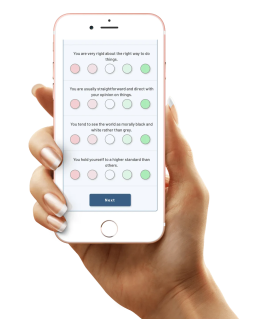


The Best Emotional Intelligence Tests for Recruitment & L&D
Technical skills get candidates in the door — but emotional intelligence keeps teams performing. Our EI tests help you assess self-awareness, social skills, empathy, and workplace behavior.
Understanding Advanced Emotional Intelligence Architecture
Emotional intelligence represents the convergence of cognitive psychology, neuroscience, and organizational behavior—measuring the interpersonal and intrapersonal competencies that drive leadership effectiveness, cultural agility, and sustainable organizational performance.
Emotional Competency Framework
-
 Executive emotional regulation and stress resilience optimization
-
Advanced self-awareness and meta-emotional intelligence
-
Strategic emotional influence and inspirational leadership capabilities
-
Cross-cultural emotional intelligence adaptability and global mindset development
Psychosocial Leadership Indicators
-
Sophisticated empathic accuracy and perspective-taking abilities
-
Complex social dynamics navigation and stakeholder management
-
Conflict transformation and collaborative problem-solving expertise
-
Organizational culture development and change leadership capacity
Why Global Leaders Trust MyAnatomy's EI Platform
Cross-Cultural Normative Excellence
Our database encompasses senior executives across diverse cultural contexts, establishing the most sophisticated cross-cultural benchmark for leadership EI assessment.
Scientifically-Validated Psychometric Framework
Developed with leading organizational psychologists and neuroscience researchers, our assessments meet the highest standards of scientific rigor for multinational corporations.
Predictive Leadership Analytics
Advanced machine learning algorithms analyze emotional intelligence patterns to predict long-term leadership effectiveness, cultural fit, and organizational impact with unprecedented precision.
Enterprise Integration Architecture
Seamless integration with existing talent management ecosystems, leadership development programs, and succession planning frameworks for global organizations.
What Are Emotional Intelligence Tests?
These tests evaluate how candidates manage emotions, build relationships, and navigate social dynamics, crucial for collaboration and leadership roles.
-
Self-regulation and emotional control
-
Social awareness and interpersonal skills
-
Conflict resolution and team interaction
-
Empathy and leadership potential
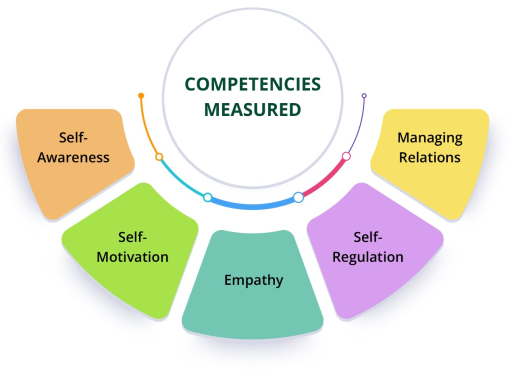
Emotional Intelligence Tests
Self-Awareness & Regulation
Evaluate emotional self-control, stress management, and personal insight capabilities.
Empathy & Social Awareness
Test ability to understand others' emotions, read social cues, and demonstrate compassion.
Relationship Management Skills
Measure conflict resolution, influence, teamwork, and leadership communication abilities.
Adaptability & Resilience
Assess flexibility, optimism, and ability to thrive under pressure and change.
Why Use MyAnatomy's Emotional Intelligence Tests?
Benchmarked against a diverse global dataset of 10,000+ candidates across geographies, industries, and job roles
Frequently Asked Questions
Why should emotional intelligence be assessed during hiring and not just technical skills?
Technical skills determine whether a candidate can do the job. Emotional intelligence determines how well they will do it within a team, under pressure and over time. Candidates with high EQ communicate more effectively, resolve conflict constructively, adapt to change and lead with greater impact. Assessing EI early in the hiring process significantly improves the quality and longevity of every hire.
What specific aspects of emotional intelligence do these assessments measure?
The assessments evaluate four core dimensions — self-awareness and emotional regulation, empathy and social awareness, relationship management and conflict resolution, and adaptability and resilience under pressure. Together these provide a comprehensive picture of how a candidate manages their own emotions and navigates the emotions of those around them in a professional environment.
Are emotional intelligence assessments reliable or too subjective to be useful in hiring?
EI assessments are often misunderstood as subjective. MyAnatomy's framework is built on the convergence of cognitive psychology, neuroscience and organisational behaviour — developed with scientific rigour and validated against a global dataset of 10,000+ candidates. The results are consistent, benchmarked and defensible — making them a reliable input for structured hiring decisions.
Which roles benefit most from emotional intelligence assessments?
EI assessments are particularly valuable for leadership roles, client-facing positions, team management functions and any role that requires collaboration, stakeholder engagement or conflict resolution. However, as workplaces become more dynamic and cross-functional, EI has become a critical differentiator across virtually every professional role and level.
How do EI assessments help with leadership hiring specifically?
Leadership effectiveness is deeply tied to emotional intelligence. Leaders with high EQ inspire trust, manage stress constructively, navigate complex social dynamics and drive cultural alignment. MyAnatomy's assessments identify these traits before appointment — reducing the risk of leadership mis-hires that can impact entire teams and organisational culture.
Can emotional intelligence be developed or is it fixed? Does that affect how we use assessment results?
EI is developable — which makes assessment results valuable not just for hiring but also for Learning and Development. Assessment reports identify specific EI gaps that can be addressed through targeted coaching and development programmes. Many organisations use MyAnatomy's EI assessments as a baseline for leadership development journeys, not just recruitment decisions.
How are candidates benchmarked and what does that mean practically?
Every candidate is benchmarked against a diverse global dataset of senior executives and professionals across industries, geographies and cultural contexts. This means your hiring team can see not just how a candidate scores in isolation but how they compare to high-performing professionals in similar roles — adding meaningful context to every shortlisting decision.
Are these assessments culturally sensitive for organisations hiring across different geographies?
Yes. The framework has been developed with cross-cultural normative benchmarking at its core — accounting for diverse cultural contexts and leadership expectations. This makes the assessments reliable and fair for organisations hiring across international markets where emotional expression, communication styles and interpersonal norms may vary significantly.
How do EI assessments complement technical and cognitive evaluations in a hiring process?
Technical assessments answer what a candidate can do. Cognitive assessments answer how they think. Emotional intelligence assessments answer how they will work with others and lead under pressure. Used together, these three dimensions create a holistic, evidence-based candidate profile that reduces the risk of one-dimensional hiring decisions.
What measurable outcomes have organisations reported after using EI assessments in hiring?
Organisations using MyAnatomy's emotional intelligence assessments have reported a 6x enhancement in leadership effectiveness, 5x acceleration in leadership development ROI and 78% higher leadership potential scores among hired candidates. The impact is most visible in teams where collaboration, adaptability and stakeholder management directly influence business outcomes.